Failed Paver Sealer Removal & Paver Stripping New Smyrna Beach
Sunshine Pressure Washing LLC removes failed paver sealer and strips deteriorated coatings from driveways, patios, and pool decks throughout New Smyrna Beach and the surrounding area. Failed sealer may appear cloudy, white, hazy, uneven, or peeling, and correcting it can require removing some or all of the existing coating before the surface is properly prepared for future restoration or resealing. The appropriate process depends on the existing product, the surface, and the condition. Request a free estimate to have your pavers evaluated.
Service Overview
Why Does Paver Sealer Turn White or Cloudy?
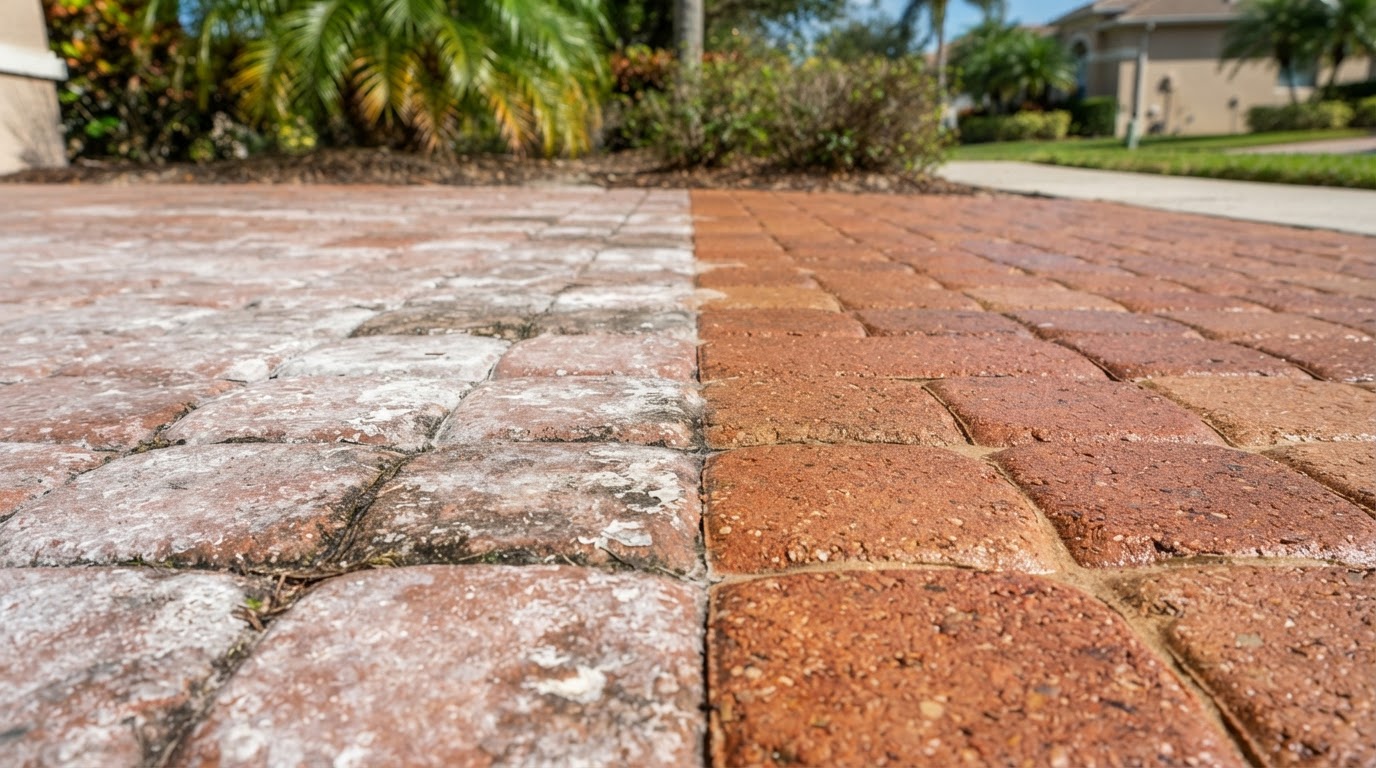
Failed paver sealer is one of the most frustrating issues a property owner encounters, because the surface often looked good right after sealing and then deteriorated over time. The coating may turn cloudy, milky white, hazy, or uneven in sheen; it can peel, blister, or develop dark and light patches that make the entire installation look worse than bare pavers would. When that happens, the question is rarely whether something went wrong — it's why, and what can be done about it now.
There is no single universal cause. Moisture is a common contributor: if moisture is present in the pavers or the joint sand when sealer is applied, or if moisture migrates upward afterward, it can become trapped beneath the coating and produce a cloudy or white appearance. Improper surface preparation is another factor — sealing over dirt, efflorescence, or an existing coating that wasn't addressed can prevent the new sealer from bonding correctly. Application conditions matter too; temperature, humidity, and direct sun at the time of application can all affect how a coating cures.
Product compatibility and layering also play a role. Applying a new sealer over an existing failed sealer, or combining products that weren't designed to work together, can produce peeling, uneven sheen, or a cloudy film. And simple aging or deterioration of an older coating can cause a sealer that once performed well to break down and turn cloudy over time. Because several of these factors can overlap, the visible symptom alone doesn't always identify the cause — which is why the surface should be evaluated rather than guessed at.
The visual signs to look for include white or milky areas, general cloudiness, a hazy film, peeling or flaking coating, uneven sheen with glossy and dull patches, and dark or light spots that weren't present when the pavers were first sealed. Any of these can indicate that the existing coating has failed and may need to be removed before the surface can be properly restored.
How the Service Works
How Failed Paver Sealer Is Evaluated Near New Smyrna Beach
Correcting a failed sealer begins with evaluation, not with immediately applying a stripping product. The goal is to understand what's on the surface, how severe the failure is, and what the pavers themselves can support before any corrective work begins. Evaluating the installation honestly is what separates a proper restoration from simply making the problem worse.
Paver Condition
The pavers themselves are assessed first — their material, age, surface wear, and overall condition. A surface that's structurally sound can support a different corrective process than one that's significantly deteriorated, and the condition of the pavers influences what stripping method is appropriate.
Type of Coating
When the existing coating can be identified, that information helps determine the removal approach. Different sealer types respond to different methods, and a coating that can't be positively identified is evaluated based on how it behaves. Not every failed coating is the same, and the stripping approach is matched to what's actually on the surface.
Severity & Coverage
The extent of the failure matters. A localized cloudy area may call for a different approach than a surface where the entire coating has failed and is peeling. Coverage area, severity, and whether the failure is uniform or patchy all factor into how the correction is planned.
Joint & Moisture Conditions
Joint sand condition and moisture patterns are checked because trapped moisture is a common cause of cloudy sealer. If the joints are compromised or moisture is migrating through the surface, those conditions need to be understood before any new coating is considered — otherwise the same failure can recur.
Stripping may involve different methods depending on the system, and no single approach works for every failed coating. The evaluation determines which method fits the surface, and the process is planned around what the pavers can support. Exact chemical recipes and concentrations aren't published here, because the appropriate product and method depend on the specific coating and condition.
Benefits & Related Services
Paver Stripping, Restoration & Resealing
Failed sealer removal is rarely a standalone finish line — it's usually the first corrective step in a broader restoration. Once the failed coating is removed, the pavers can be properly cleaned, evaluated for joint sand, and prepared for whatever finishing step the surface actually needs. The relationship between these services is what makes the difference between a surface that stays clean and one that fails again.
After stripping, paver cleaning removes the residue and buildup revealed once the coating is gone. The joints are then evaluated — if sand is missing or compromised, paver re-sanding or polymeric sand installation may be appropriate before any new coating is applied. If the pavers look faded once the failed sealer is off, color restoration options can be considered, and if white mineral haze is present, efflorescence removal may be needed.
Only after the surface is properly prepared does paver sealing become appropriate — and the broader paver restoration process ties all of these steps together based on what the installation actually needs.
One point deserves emphasis: applying more sealer over a failed coating is not automatically the correct solution. Layering new product over cloudy, peeling, or incompatible sealer often traps the existing problem underneath and can make the failure worse. That's why evaluation and removal come first.
Related Exterior Cleaning Services
The broader corrective process that combines stripping, cleaning, re-sanding, and sealing based on what your pavers need.
Paver SealingThe finishing step applied only after failed sealer is removed and the surface is properly prepared.
Paver CleaningRemoves the residue and buildup revealed once a failed coating has been stripped from the surface.
Paver Color RestorationAddresses faded or dull appearance that may be exposed once a failed sealer is removed.
Questions & Answers
Failed Paver Sealer Removal FAQ New Smyrna Beach
Direct answers to the questions we hear most about this service. If yours isn't here, request a free estimate and we'll walk through the specifics of your property.
Local Service
Request Failed Paver Sealer Removal Near New Smyrna Beach
If your paver driveway, patio, pool deck, or walkway has a sealer that turned cloudy, white, hazy, or started peeling, the coating may need to be removed before the surface can be properly restored. Sunshine Pressure Washing LLC evaluates failed paver sealer throughout New Smyrna Beach and surrounding Volusia County communities, and the corrective process is planned around the actual condition of your pavers — not a one-size approach.
The first step is an honest evaluation of the coating, the paver surface, and the joint condition. From there, the appropriate stripping, cleaning, and restoration steps can be determined. Request a free estimate to have your pavers reviewed, or call to discuss what you're seeing.
Request a Free Estimate
Tell us about your property and the surfaces involved — we'll review the details and follow up with next steps.
Prefer to call?
Speak with us directly about your property. We provide free estimates with no obligation.
Sunshine Pressure Washing LLC386-314-6959
info@sunshinepressure.com
New Smyrna Beach, Florida
Second location: 1231 Willow Oak Dr., Edgewater, Florida