Irrigation Rust & Well-Water Stain Removal New Smyrna Beach
Sunshine Pressure Washing LLC removes irrigation rust and well-water stains from concrete, pavers, walls, and exterior surfaces throughout New Smyrna Beach and the surrounding area. Irrigation and well-water staining can leave orange, yellow, or brown mineral-related discoloration that standard pressure washing alone may not always remove, because the discoloration can differ from ordinary dirt or organic buildup. Request a free estimate to have the staining evaluated.
Service Overview
What Causes Irrigation Rust Stains in New Smyrna Beach?
Orange, brown, or rust-colored staining on exterior surfaces is a common frustration for Florida property owners, and it often traces back to the water hitting those surfaces rather than the surfaces themselves. Irrigation systems and well water can carry dissolved minerals — iron in particular — that leave behind discoloration as the water evaporates. Understanding what causes the staining helps explain why it doesn't respond to ordinary cleaning the way dirt or algae-like growth does.
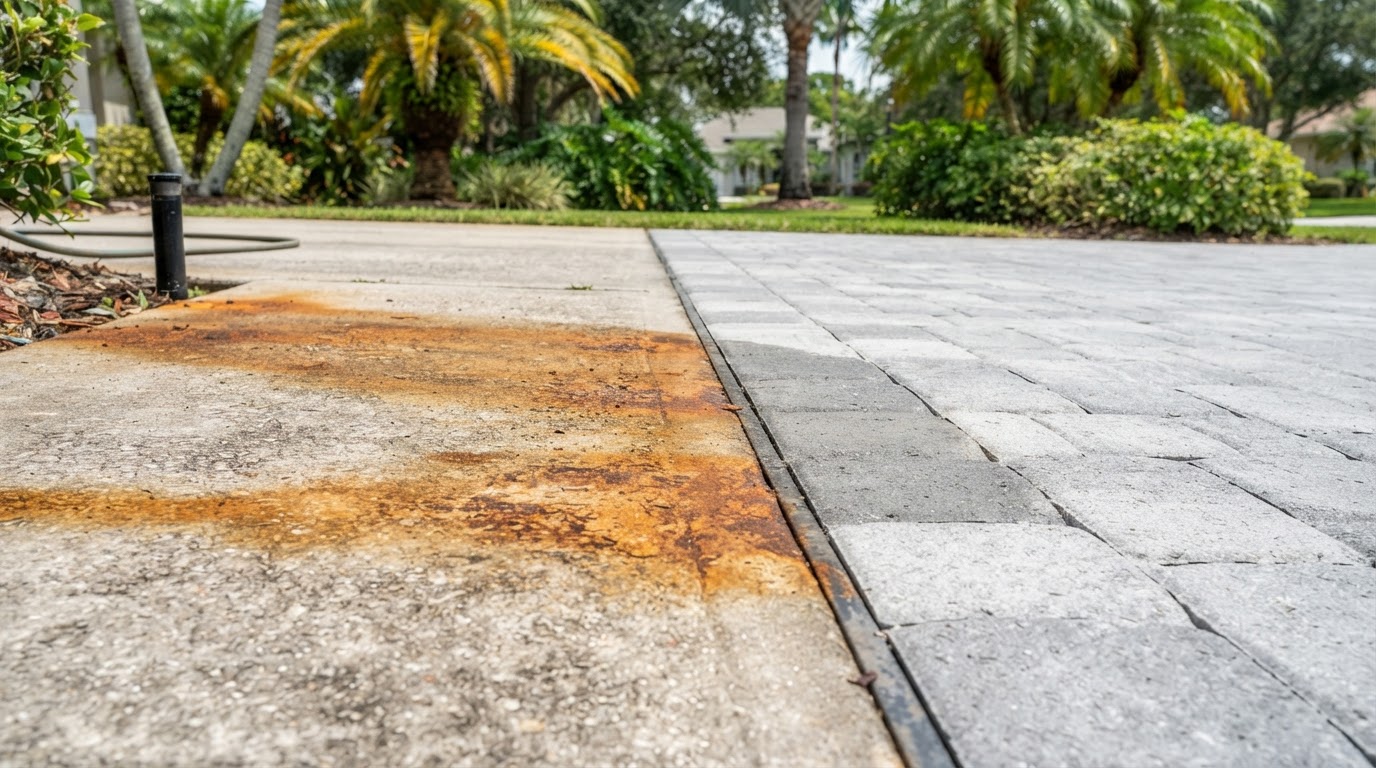
When mineral-containing irrigation or well water repeatedly contacts a surface, the water evaporates and leaves mineral residue behind. Over time and repeated exposure, that residue builds into visible orange, yellow, or brown staining. Sprinkler overspray is a frequent culprit — a sprinkler head that hits a driveway, sidewalk, wall, or fence on every cycle can produce a distinct pattern of discoloration in the spray zone. The surface porosity matters too, because porous materials like concrete, pavers, and masonry can absorb and hold mineral deposits more readily than smooth, sealed surfaces.
It's important not to assume every well has high iron or that every orange stain has the same cause. Water chemistry varies from one property to another, and not all orange discoloration is irrigation-related — metal objects, fertilizer, and other sources can also produce rust-colored staining. That's why the stain is evaluated rather than diagnosed remotely. What's consistent is that mineral-related irrigation staining tends to be stubborn and persistent, reappearing after ordinary washing if the mineral deposit itself isn't addressed.
Common areas affected include driveways, sidewalks, pavers, exterior walls, fences, curbs, and patios — essentially any surface in the path of irrigation overspray or runoff. The staining often appears as streaks running down from sprinkler zones, as orange patches in spray patterns, or as discoloration along the base of walls where runoff collects.
How the Service Works
How Irrigation Stains Are Evaluated Near New Smyrna Beach
Because orange and brown staining can have several causes, and because different surface materials respond differently to treatment, the evaluation focuses on identifying what the stain actually is and what surface it's on before any treatment is selected. Applying a generic approach without understanding the stain and surface can be ineffective or even damaging.
Surface Material
The surface material is the first consideration. Concrete, pavers, painted surfaces, and vinyl each have different porosity, sensitivity, and treatment considerations. A treatment appropriate for concrete may not be appropriate for a painted wall or vinyl fence, so the material is identified before any approach is chosen. Existing sealer on pavers or concrete is also noted, since sealer affects how the stain sits on the surface and how it can be treated.
Stain Color, Severity & Exposure
The color of the staining — orange, brown, yellow, or reddish — and its severity are assessed. Light surface discoloration may respond differently than deeply embedded staining that has built up over years of exposure. The length of exposure matters, because older stains can be more stubborn than recent ones. Any previous treatment the property owner has attempted is noted, since prior cleaning efforts can affect the surface condition.
Irrigation Pattern & Surface Porosity
The nearby irrigation pattern is considered, because the source of the staining affects whether treatment will be effective and whether the stain is likely to return. If sprinklers continue to hit the surface, the staining may recur after treatment unless the irrigation is adjusted. Surface porosity is evaluated because porous materials hold mineral deposits differently than dense or sealed surfaces, which influences the treatment approach and expected results.
No strong-acid mixing ratios or DIY chemical recipes are provided here. The treatment is selected based on the surface material, the type of staining, and the severity of the deposit, and it's applied with attention to not damaging the surface. The evaluation determines what the discoloration actually is before any product is used, because treating irrigation staining like ordinary dirt — or like efflorescence — won't produce the right result.
Benefits & Related Services
Rust Stain Treatment, Pressure Washing & Paver Restoration
Irrigation rust and well-water stain removal connects to several related services, and the relationship matters because mineral staining often coexists with ordinary dirt and organic buildup. Concrete cleaning and driveway cleaning remove surface dirt and organic growth, but they may not resolve mineral deposits — which is why a property owner who has cleaned a surface and still sees orange staining may be dealing with irrigation-related discoloration rather than dirt.
On paver surfaces, irrigation staining can connect to paver cleaning, paver restoration, and paver sealing. If the staining has penetrated the paver surface, restoration may be considered alongside stain treatment, and sealing after treatment can help protect the surface — though sealing doesn't guarantee the staining won't return if the irrigation source persists.
An important distinction: efflorescence and irrigation staining are different problems, even though both are mineral-related. Efflorescence usually presents as a white powdery or hazy deposit, while irrigation and well-water staining typically appears as orange, brown, or rust-colored discoloration. Because the treatments differ, identifying the type of discoloration matters before any treatment is chosen. Applying an efflorescence treatment to irrigation staining — or vice versa — won't address the actual problem.
For staining on vertical surfaces, house washing and fence cleaning address the surrounding exterior, and stain treatment can be evaluated as part of the overall scope. The surface is assessed to determine what combination of cleaning and stain treatment is appropriate.
Related Exterior Cleaning Services
Removes surface dirt and buildup from concrete, though mineral staining may require specific rust treatment.
Paver CleaningCleans paver surfaces where irrigation staining may also be present alongside ordinary buildup.
Driveway CleaningAddresses driveway surfaces commonly affected by sprinkler overspray and runoff staining.
Efflorescence RemovalAddresses white mineral deposits, which differ from orange irrigation-related staining and require a different approach.
Questions & Answers
Irrigation Rust Removal FAQ New Smyrna Beach
Direct answers to the questions we hear most about this service. If yours isn't here, request a free estimate and we'll walk through the specifics of your property.
Local Service
Request Irrigation Rust Removal Near New Smyrna Beach
If orange, brown, or rust-colored staining from irrigation or well water is affecting your driveway, pavers, walls, or other exterior surfaces, standard pressure washing may not be enough. Sunshine Pressure Washing LLC evaluates and treats irrigation and well-water stains throughout New Smyrna Beach and surrounding Volusia County communities, and the approach is selected based on your surface material and the type of staining present.
Because mineral staining can resemble other conditions — and because results depend on surface and stain severity — the surface is evaluated before any treatment is chosen. Request a free estimate to have the staining reviewed, or call to discuss what you're seeing.
Request a Free Estimate
Tell us about your property and the surfaces involved — we'll review the details and follow up with next steps.
Prefer to call?
Speak with us directly about your property. We provide free estimates with no obligation.
Sunshine Pressure Washing LLC386-314-6959
info@sunshinepressure.com
New Smyrna Beach, Florida
Second location: 1231 Willow Oak Dr., Edgewater, Florida